Below is an excerpt from the Akhal-Teke Association of America’s website. All images are credit to the original source.
The Breed – Akhal-Teke Association of America
"After the industrial revolution in Russia, horses lost a lot of their valued utility. Many were still used in mounted militia, with Akhal-Tekes notably used the Turkmen Calvary, but great numbers died during the World Wars. Bolshevism brought “an end to private ownership and the horses were placed in state-owned stud farms. Rather than surrender their beloved horses to such a fate many tribesmen fled with them to Persia and Afghanistan. When it was then decreed that the horses in the stud farms were to be slaughtered for food, breeders released them into the desert, their natural habitat, thereby preventing what may have resulted in the annihilation of the Akhal Teke breed within the borders of Turkmenistan” (source). Still, the Akhal-Tekes numbers suffered to the point of near-extinction. Fortunately, a few key events turned the tides for the breed.
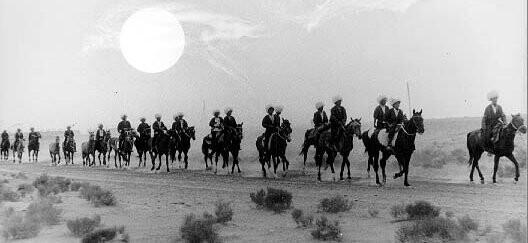
In 1935, fifteen Akhal-Teke horses, along with another native Turkmen breed and Anglo Akhal-Tekes, famously completed a 3,000km ride from Ashkhabad to Moscow in 85 days. The route required the horses to cross about 300 miles of Karakum desert, rugged swamps, and long stretches of forest (source). At the end of the ride, the Akhal-Tekes “arrived in significantly better condition than the Anglo-Teke crosses, impressive evidence for the superiority of the purebred Akhal-Teke for hardiness and endurance” (source). The event proved to Russia that the horses were finest in their purity and that the breed should not be diluted.
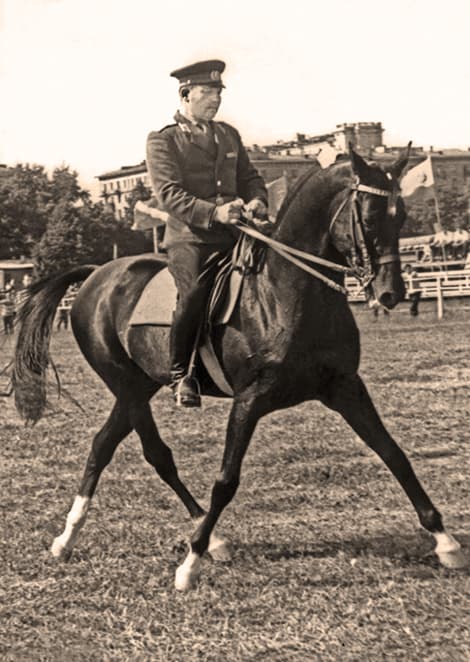
One of the Akhal-Teke horses who completed the ride was a grey stallion named Arab. He was gifted to Stalin and later became a champion in eventing and jumping, even setting a world record at the age of 16 (source) and winning the “‘The Cup of the Soviet Union’ in 1949” (source). Arab went on to become a successful stud and sired one of the most well-known Akhal-Tekes in modern times, the black stallion Absent (sometimes spelled Absinthe). Absent’s name brings with it a sense of pride for the Akhal-Teke as an elegant, modern athlete. Under the keen and sensitive direction of rider Sergei Filatov, Absent secured the first Olympic Gold victory for Soviet Russia in 1960. His legacy includes many progeny with the same aptitude for dressage and talent for jumping from his sire Arab. In fact, “Russian Grand Prix rider Inessa Poturaeva [competed] on a grandson of him, Amaretto” (source).
In 1941, the first official stud book with Akhal-Tekes was published, however in 1973 the All-Russian Institute of Horsebreeding (VNIIK) was established as the official international Akhal-Teke stud book for their recovery.
Highlighting their prized nature, the Akhal-Teke have been given as political gifts for ages. In recent centuries, they have been gifted from Turkmenistan to England, Russia, and France. “In 1956, for example, Nikita Khrushchev presented Queen Elizabeth the bright golden-dun stallion Melekush. So the story goes, grooms tried to clean off what they thought was an unnatural polish, but Melekush glowed even more awash” (source). This practice also helped improve their renown internationally.
In addition to breeders in Turkmenistan, several key Russian stud farms are credited for preserving the breed into the modern day, and now the Akhal-Teke can be found worldwide. Their numbers are currently over 6,000 globally and steadily growing, as is their popularity. Unfortunately, the breed is still at risk, especially because they are spread out and many regions have limited genetic pools. The Akhal-Teke is considered a “threatened” heritage breed by the Livestock Conservacy, and requires continued vigilance for futures generations to enjoy."
What else do we know about the Akhal-Teke’s modern history? I’d love to see any further sources, stories, records, or traces for the Akhal-Teke in a more modern context post-1800.